
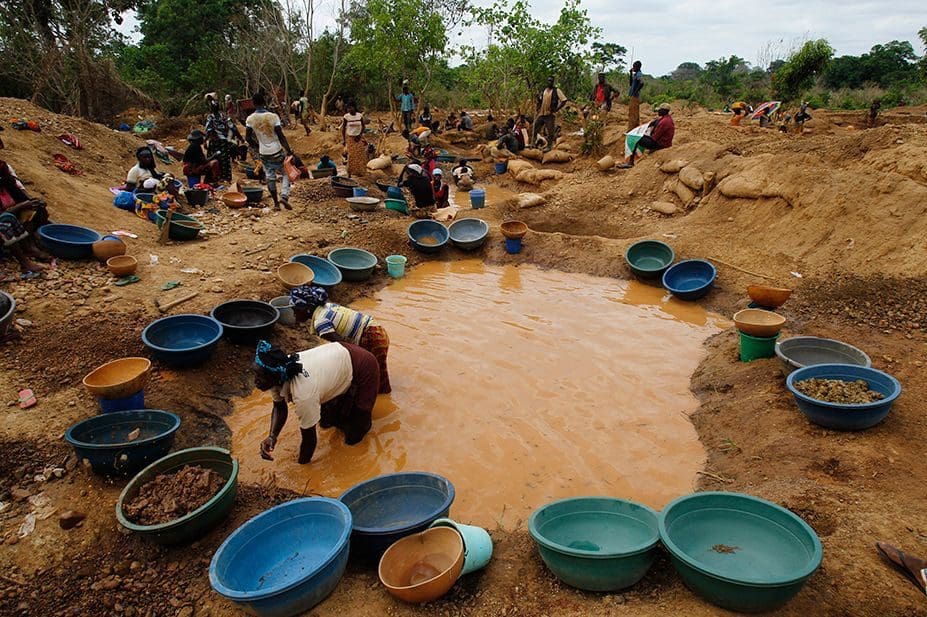
Between Guinean sovereignty, Sahelian solidarity and free movement, the closure of the Siguiri gold sites triggered one of the largest population movements in the subregion. It also obliges ECOWAS and AES to speak. A mining police decision became a major diplomatic issue in three weeks. Conakry suspended the artisanal goldwork in Upper Guinea from 29 October and announced more stringent measures on 2 November. Since then, tens of thousands of West Africans have left the country by expulsion or forced departure.
An exodus of unprecedented magnitude
The figures give the measure of the crisis. The Government of Burkina Faso announced the end of its repatriation operation, with 76,169 people brought back by 18 November, including nearly 16,000 children. Nearly 2,000 nationals from other countries, including Togolese, Beninese, Ivorian and Nigerian, were taken into care in reception centres in Burkina Faso.
On the Malian side, the authorities have referred to about 160,000 people who have arrived from Guinea since the beginning of the month, most of them at the Kurémalé border crossing. Benin had also deployed a consular mission to Mali and Burkina Faso to repatriate its nationals, and Togo was preparing for the return of its nationals.
The judicial component increases the balance sheet. Conakry opened a massive trial against more than a thousand people of several nationalities. On 14 November, 1,557 West African nationals, sentenced to 18 months to two years in prison, were released and then expelled by convoy to Kurémalé. The Guinean government also reported at least 10 deaths in Siguiri during clashes between law enforcement and goldsmiths.
Conakry assumes, his neighbors deplore
Guinean chief of diplomacy, Morissanda Kouyaté, defended his country's firmness before the ambassadors accredited in Conakry. In his view, pan-Africanism and solidarity between states could not serve as a pass-right to break the law. He invoked environmental damage, the destruction of rivers and forests, and assured that the processing of cases was done through diplomatic channels.
In Bamako and Ouagadougou, the tone remained measured, which is even more striking. General Abdoulaye Maiga regretted a « Non-concerted return » while claiming to respect Guinean sovereignty. Burkina Faso Security Minister Mahamadou Sana spoke about an operation « very deplorable » of which Ouagadougou had not been warned.
This restraint is explained by the fact that General Mamadi Doumbouya's Guinea, although outside the confederation, is traditionally regarded as an ally by AES states. For the first time, their foreign ministers also took a joint position, deploring evictions « Massive and uncoordinated ».
Free movement test
Beyond the humanitarian emergency, the crisis raises questions of law and doctrine. The African Charter on Human and Peoples' Rights prohibits collective expulsions of foreigners. The ECOWAS protocol on free movement guarantees Community nationals the right to move and settle.
These texts have been of particular weight since the actual withdrawal of Mali, Burkina Faso and Niger from ECOWAS on 29 January 2025, as these countries claimed that their departure did not undermine free movement. Several analysts point out that a state has the right to regulate its mining sector, but that the method counts. A brutality between neighbours would weaken Africa's voice when it denounces the refoulements at Europe's borders.
Dakar as a discreet mediator
Senegal has positioned itself on this ground. On 6 November, the Minister of African Integration and Foreign Affairs, Sheikh Niang, was received in Niamey by Nigerian Prime Minister Ali Mahaman Lamine Zeine, carrying a message from President Basirou Diomaye Faye to General Abdurahamane Tiani.
He called for enhanced dialogue between ECOWAS and AES and for the preservation of the free movement of persons and goods. The visit was a little ahead of the scale taken by the Guinean crisis, which gives its message a special resonance.
This sequence shows that regional recomposition is no longer confined to peaks. It is played at borders, on the concrete management of the flows of people. A formalization of artisanal goldmaking, referred to by analysts, and a framework for consultation between Conakry, AES and ECOWAS now appear as conditions to prevent the next unilateral measure from producing the same shock.