
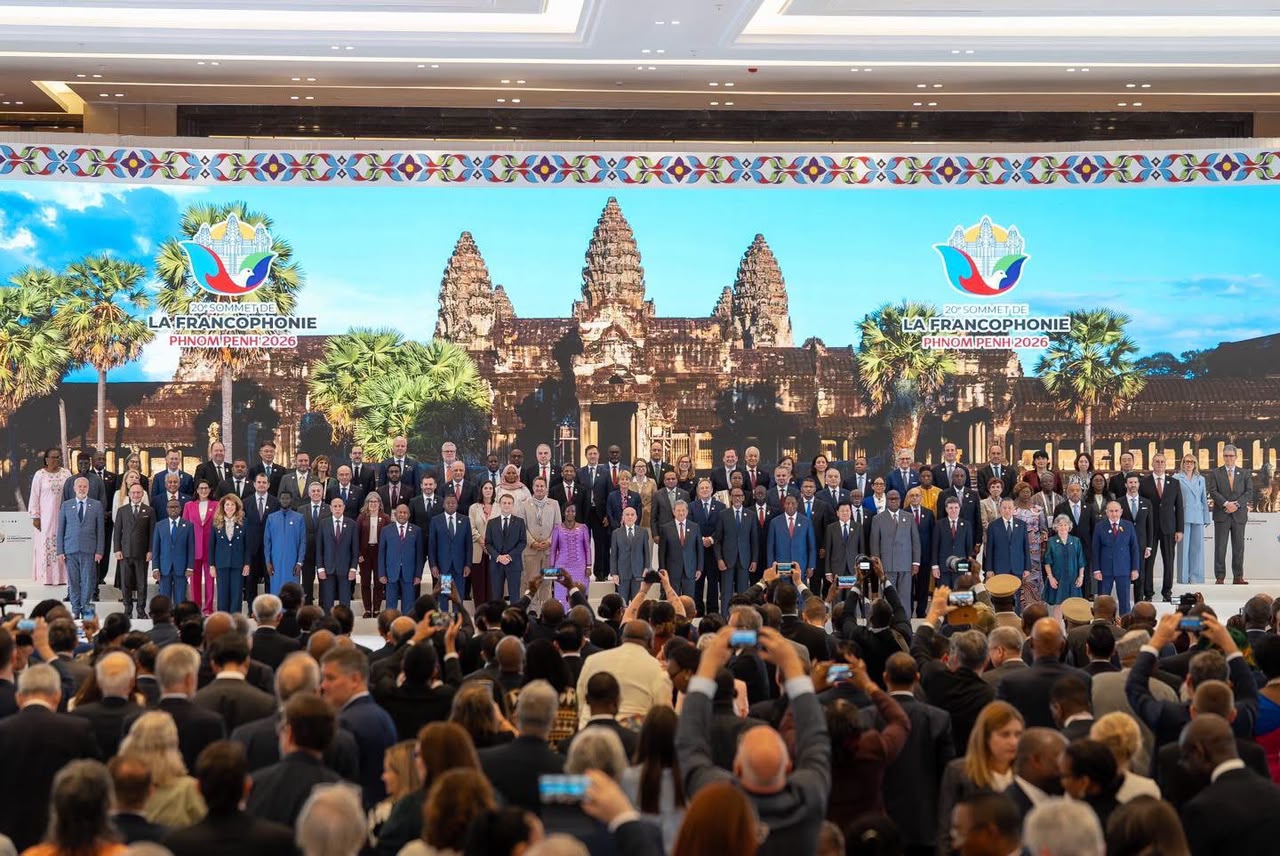
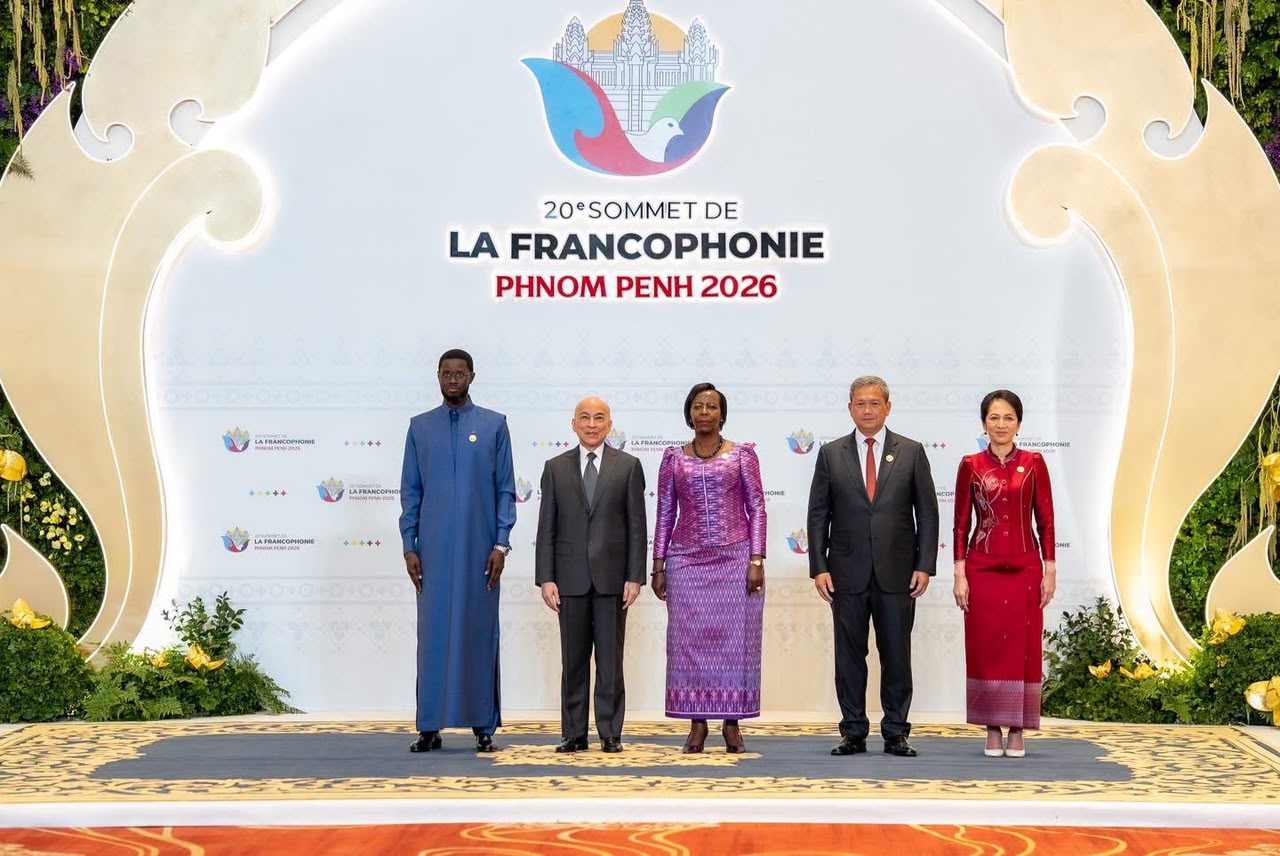
The 20th Summit of La Francophonie, held on 15 and 16 November in Cambodia, adopted a declaration for peace but could not appoint a secretary-general. For the first time, the election was postponed for lack of consensus, on the background of a confrontation between Kinshasa and Kigali. The continent that brings the French language to life comes from a central and divided summit.
For Cambodia, it is the first Francophonie Summit organized on its soil and the second in Asia. Phnom Penh was not chosen at random: La Francophonie owes Cambodia one of its four founding fathers, King Norodom Sihanouk. The summit was initially planned in Siem Reap. Phnom Penh finally welcomed him, in order to guarantee better organizational conditions, explained the Cambodian Ministry of Foreign Affairs in February 2026.
At the opening, on Sunday, 15 November, in the presence of King Norodom Sihamoni, Emmanuel Macron, Prime Minister Hun Manet and Secretary General Louise Mushikiwabo, France handed over to Cambodia the presidency of the summit it had held since October 2024.
Africa, first concerned
The figures explain the issue. According to data from Africa24, there were 396 million speakers in French-speaking areas in 2026, 65 per cent of whom were in Africa, and could reach 590 million in 2050, including nine out of ten in Africa.
This reality was seen in the Village de la Francophonie, located in the Wat Botum garden. Nearly 100,000 visitors were expected until 17 November, with about 30 conferences, about 50 shows and 30 food stands.
African stands attracted crowds. Rwanda had its national ballet danced there in a promotional operation that also supported its candidate. Côte d'Ivoire relied on cocoa and zuglou. Senegal referred to Senghor's legacy and held four conferences around its vision Senegal 2050. The representative of the Senegalese Head of State to the OIF, Mohamed Konté, pleaded for a Francophonie of the daily.
African leaders in Phnom Penh
Senegal is a founding country: the Institutional Francophonie was created in Niamey in 1970 by Senghor, Diori, Bourguiba and Sihanouk. President Bassirou Diomaye Faye arrived on November 13, after the Paris Peace Forum. At the opening, he paid tribute to Senghor.
The Senegalese presidency indicated that Dakar would defend an approach to peace based on dialogue of cultures, cooperation between regional organizations and investment in youth. On the parliamentary side, El Malick Ndiaye, Acting President of the Parliamentary Assembly of La Francophonie, led the delegation of the APF.
The President of the Togolese Council, Faure Gnassingbé, was among the Heads of State and Government present at the opening. Rwandan presidents Paul Kagame and Congolese Felix Tshisekedi were also expected. Mauritania, together with President Ghazouani, had a direct interest in the election with the candidacy of Coumba Ba.
A peace, youth and digital declaration
In the Phnom Penh Declaration, leaders affirm that peace, prosperity and stability are inseparable, and that dialogue is a condition for achieving them. They are also concerned about the loss of confidence in institutions.
The text calls for the consolidation of OIF's action on crisis prevention, support for peace processes through mediation and support for democratic transitions, and calls for closer dialogue with regional and international organizations.
It also calls for increasing La Francophonie's contribution to global digital governance and an ethical AI, with a strengthening of the digital skills of young people and women. On the environment, it links the triple crisis of climate, biodiversity and pollution to the challenges of peace and security.
Three major documents were adopted: the Declaration, a Resolution on Crisis Situations and Phnom Penh's Call on Cultural Heritage and Cultural Diversity.
The latter is a Cambodian initiative that builds on the country's experience to protect its heritage despite the destructions caused by conflict. The summit also welcomed two new observers, the Canadian Province of Manitoba and Saint-Christophe-et-Niévès.
Absences from the Sahel and RDC-Rwanda rivalry
An absence marked the summit. Burkina Faso, Mali and Niger, members of the Confederation of Sahel States, announced their withdrawal from OIF in March 2025. They had nevertheless participated in the creation, in 1970 in Niamey, of the Agency for Cultural and Technical Cooperation, ancestor of the organization. This departure is an important setback and creates a precedent that other members could follow.
The political stake of the summit was the succession of Louise Mushikiwabo. Kigali had formalized his candidacy for a third term in January. Kinshasa responded in February with Juliana Lumumba, in a context of intense tensions between Tshisekedi and Kagame.
According to RFI, the DRC, which accuses Rwanda of supporting M23 rebels in the east of the country, has done everything possible to prevent this third mandate. Rwanda, for its part, denounced pressure from Paris and assured that its candidate would go to the end.
The friction has worsened in the last few days. Emmanuel Macron proposed that Kigali and Kinshasa both renounce their candidate, in order to reach a consensus on one of the other two candidates.
On Saturday, the DRC said it was ready to withdraw Juliana Lumumba and study a common approach in favour of the Romanian Dacian Cioloș, which some media have described as an effective withdrawal. On Sunday, against Paul Kagame, the French President invited DRC, Rwanda and Mauritania to find a « African consensus » that France would support. He reiterated this appeal to the Heads of State on Monday, in vain.
A French diplomatic source spoke of a « Night of the long knives » to describe the day before the vote. According to RFI, the negotiations lasted more than three hours, until the last minute.
Unpublished deferral and a one-year transition
Members of their own right have renounced the appointment of their future Secretary-General. It is a first for the institution, which had always appointed its Secretary-General by consensus since 1997. The vote was postponed by one year.
Louise Mushikiwabo's term of office is extended to an extraordinary elective summit, to which she will not appear according to several RFI sources. The candidatures of Juliana Lumumba, Mauritanian Coumba Ba and Dacian Cioloș are maintained, and news can be submitted.
The reactions are mixed. Dacian Cioloș deplored a very sad day for La Francophonie, which may leave deep traces. Emmanuel Macron, on a state visit, greeted a « compromise » Elysée congratulated the members on their responsibility and ability to reach agreement. Kinshasa, through its communication minister Patrick Muyaya, believes that his voice has been well heard and that the unity of La Francophonie has been preserved.
Africa weighs by the number of speakers, its founders and the incumbents of the post: three of the four Secretaries-General since 1997 are African. But this strength is also a weakness.
The blockage came from a rivalry between two African states, and the Paris call for an African consensus between Kinshasa, Kigali and Nouakchott shows that the choice is first made between Africans. With the Sahel party, the OIF has a year to restore consensus before the extraordinary summit. Opening up new applications can also redistribute cards.
Canada was designated host country for the 21st Summit. According to RFI, it will be held in Ottawa on September 7 and 8, 2028. Until then, La Francophonie will have to transform the Declaration into concrete actions and choose its direction.