
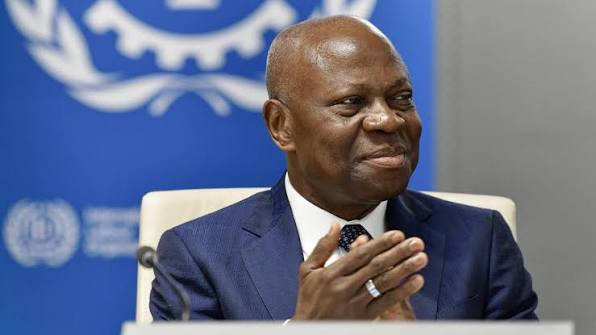
Togolese Gilbert Fossoun Houngbo was reappointed, Monday 16 November 2026 in Geneva, to the General Directorate of the International Labour Organization (ILO). As the first African to hold this position, he obtained a second five-year term in a context that his supporters and critics considered demanding: a financial crisis, a change in work under the influence of artificial intelligence, internal tensions. Back to an unsurprising election and the stakes it opens for African diplomacy.
The decision was taken at the 358th session of the ILO Governing Council. According to Xinhua, Mr. Houngbo's second term of office will begin on 1 October 2027 and end on 30 September 2032. Financial Afrik reported 51 votes out of 56 votes cast.
The voting method clarifies the scope of this result. The Director General of ILO is elected by secret ballot by the 56 members of the Governing Council, the executive body of the Organization. This reflects the tripartite nature of the institution: 28 seats for governments, 14 for employers and 14 for workers. Getting such a large majority therefore means bringing together far beyond States alone.
The Swiss Daily Time Moreover, he noted that the re-election had gone smoothly, even though the management of the Organization was being criticized, particularly by Switzerland.
A path made in multilateralism
Born in Togo in 1961, Gilbert Houngbo built most of his career in international institutions. He held several positions in the United Nations Development Programme (UNDP) between 1996 and 2008, before becoming Prime Minister of Togo from 2008 to 2012. He then joined ILO as Deputy Director General (2013-2017) and then chaired the International Fund for Agricultural Development (IFAD) from 2017 to 2022.
Elected in March 2022 against four other candidates, including former South Korean Foreign Minister Kang Kyung-wha, Australian Greg Vines and Frenchwoman Muriel Pénicaud, he took office in October 2022. He then became ILO's eleventh Director General and the first from the African continent, 103 years after the establishment of the Organization.
Re-election by Africa
Mr Houngbo's candidacy received official Lomé support. It has also mobilized African actors in the field of work.
Last June, in Geneva, the boss of Senegalese employers Baidy Agne, accompanied by representatives of employers' organizations from Algeria and Zambia as well as African employers on the Board of Directors, pleaded for a stronger ILO and called for a second term for the outgoing Director General.
Congratulations quickly flowed to the continent: Benin welcomed the re-election of « experienced man ». For the specialized press, this result is a consecration for Togolese diplomacy, but also a signal for the whole of Africa, which sees one of its confirmed heads of a central agency of the United Nations system.
The challenges of a second mandate
In his speech after the vote, delivered in French, the Director General identified the transformation of the labour market by artificial intelligence as the main challenge ahead, saying that the Organisation should be « at the vanguard » of this reflection so that technological progress remains at the service of humans.
But the most pressing issue is financial. According to Togonews, The United States, traditionally the ILO's largest contributor, has suspended payments, and the Organization has warned that it may need to reduce its staff.
The Director General, for his part, highlights the reforms carried out during his first mandate, including the modernization of the system of monitoring international labour standards.
These management choices are not unanimous. According to Time, Switzerland, the host country, was concerned about the abolition of posts, a lack of internal social dialogue and the transfer of the Organisation's European office to Brussels. A paradox for an institution whose raison d'être is precisely the promotion of social dialogue.
What it changes for Africa
Beyond the person, this re-election raises questions useful for African diplomacy.
- A presence to be consolidated. Holding the management of a UN agency is a rare influence lever. It is up to the African States to transform it into concrete priorities: youth employment, social protection and the informal economy, which affects the vast majority of workers on the continent.
- Artificial intelligence and employment. While African youth are called upon to dominate the world's labour force, the way in which the ILO will govern the digital revolution directly affects the economies of the continent.
- Africa's ability to weigh in appointments. This victory reminds us that candidates supported by active diplomacy and tripartite alliances, states, employers and workers, have real chances of success.
Looking ahead
In the opinion of several observers, this second term will also be the last: the Director General himself presents him as such. It therefore has five years, beginning in October 2027, to complete its reforms, stabilize the Organization's finances and leave a clear path for its successor. Re-election is a diplomatic victory; It is the management of the crisis that will tell if it becomes a balance sheet.