
Dr Alain-Patrick LOUMOU MONDOLEBA , Politician, Researcher
In 2024, 69 cases of femicides were recorded in Cameroon, compared with 56 in 2023, according to data from a Cameroonian institutional publication. In January 2025, ten new cases were documented by Griote TV. These figures are not, however, an exhaustive counter, but available traces of a phenomenon whose measurement remains fragile. The Ministry for the Advancement of Women and the Family itself emphasizes, in its situational analysis of gender-based violence, the worrying and structural nature of these homicides.
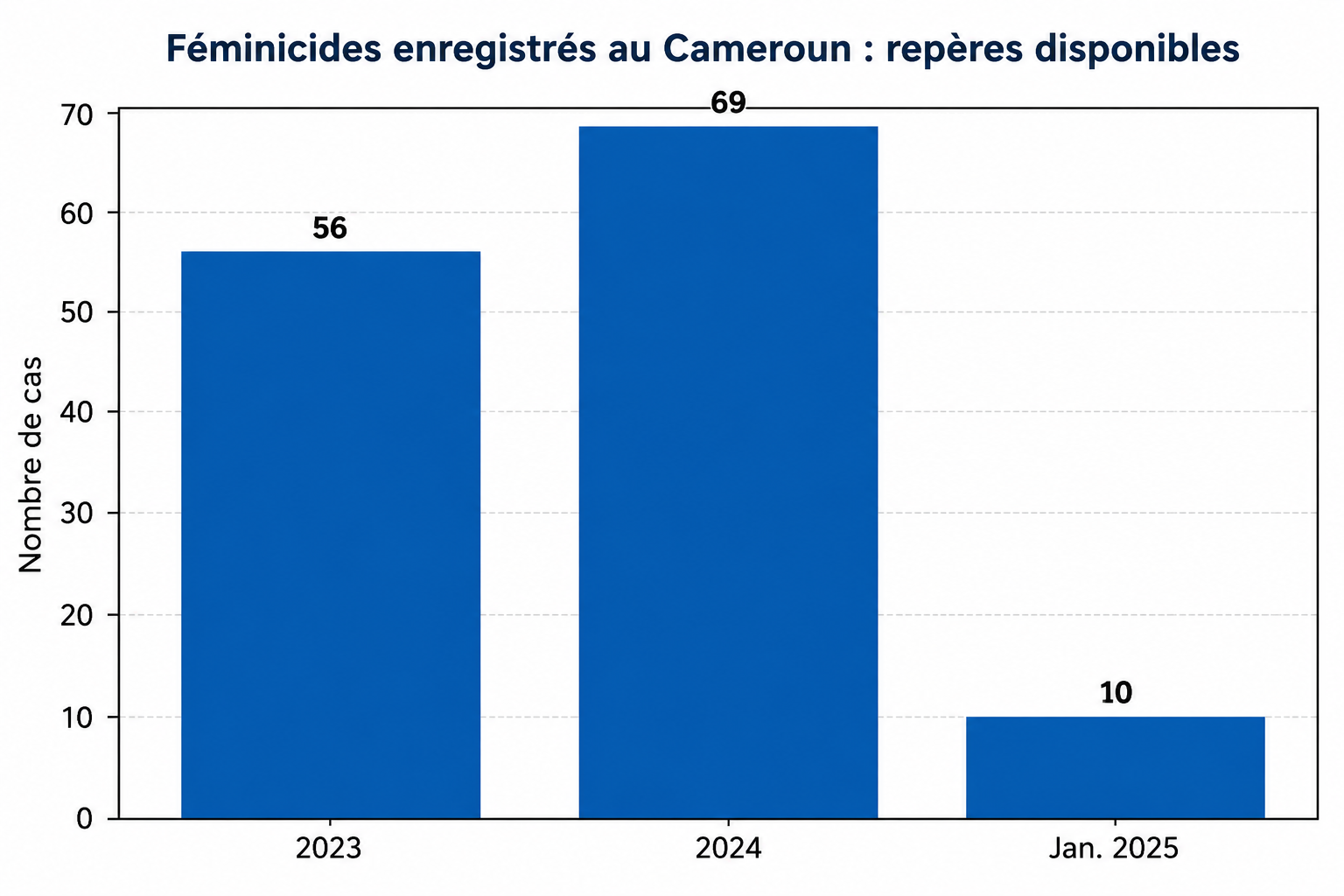
Sources: MINPROFF, Situational Analysis Report of VBG in Cameroon, 2025; BUCREP, International Women's Day 2025, MINPROFF/Griote TV data.
The problem is therefore twofold. There are first women killed. Then there are women who our statistical systems do not see. However, in terms of gender violence, invisibility is never neutral: it reduces the capacity to prevent, protect, prosecute and redress.
The femicide must be read as a problem of human security and of the government of society, not as a succession of « Other events ». As long as the violence before the murder (cuts, threats, control, sexual abuse, humiliation, economic dependence) will remain treated as private cases, the state will intervene too late.
Name the phenomenon: from homicide to femicide
The term « femicide » This refers to the intentional murder of a woman or girl when it is related to gender. The international definition used by UNODC and UN Women allows for the identification of the murders committed by an intimate partner or family member. Around 50,000 women and girls worldwide were killed in 2024 by an intimate partner or family member, or about 60 per cent of all women and girls killed intentionally that year. This represents an average of 137 victims per day.
Africa had the highest estimated regional rate for this category of femicides, around 3 per 100,000 women and girls. The notion is sociologically fruitful because it moves the look. It does not just ask: « Who killed? » It also asks: « In what social connection does this murder become possible? » This displacement is decisive in Cameroon.
The murder of a woman in the matrimonial, family or after sexual violence can be legally understood as a homicide, but this qualification is not always sufficient to understand the social mechanism that made it possible.
Femicide is not a mere homicide. « Female ». It points to violence through power relations, norms of possession, imaginations of male authority and mechanisms of banality. It is not a question of saying that all men are violent, or that all violence against women would fall under the same scenario.
Cameroon has public policies and mechanisms to combat gender-based violence, but still does not have an autonomous and general law on violence against women or an autonomous criminalization of femicide in its criminal law. UN Women identifies a national strategy to combat GBVs for 2022-2026, 39 specialized police units and 116 social services, but also the absence of an autonomous law to combat violence against women and the absence of a specific provision on marital rape.
Behind the femicides, violence already there
Perhaps the best way to understand femicide is to start before the murder. Available data on violence against women show that the transition to lethality does not always appear ex nihilo. It can be preceded by a long history of ordinary violence, sometimes invisible to institutions, sometimes visible but socially tolerated.
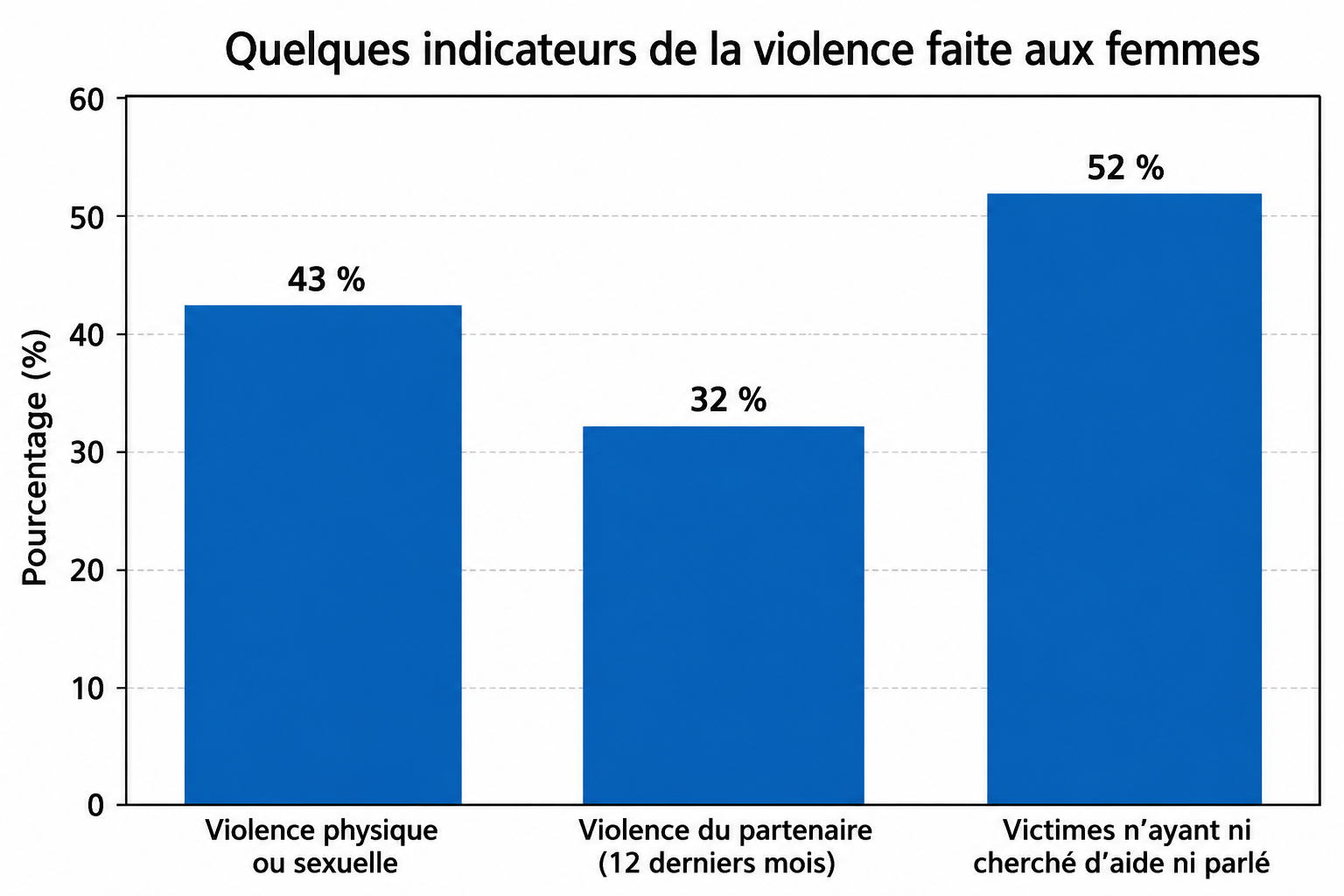
Sources: EDS Cameroon 2018; INS, Women and men, girls and boys in Cameroon 2024; Afrobarometer, dispatch number 893, 2024.
The EDS 2018 reported that 43 per cent of women aged 15 to 49 had experienced physical or sexual violence, while 32 per cent of married or separated women reported having experienced intimate partner violence in the 12 months prior to the survey. Even more worrying from the point of view of public action, the data taken by the INS show that in 2018, 52% of women victims of physical or sexual violence had neither sought help nor talked to anyone about what had happened to them.
This silence should not be interpreted as an absence of violence. On the contrary, it constitutes sociological data. He says something about how a victim anticipates the cost of speech: shame, retaliation, economic dependence, fear of separation, family pressure, lack of information, distrust of institutions or trivialization of violence.
Afrobarometer adds a normative dimension. In Cameroon, almost half of the citizens surveyed considered violence against women and girls as common in their communities. A majority felt that domestic violence should be a matter of police intervention rather than a simple family affair, but a clear majority also supported the use of physical force by men towards their wives.
This coexistence of two seemingly contradictory attitudes is sociologically revealing: a society can publicly recognize that violence is a problem while retaining norms that make it tolerable in certain circumstances.
Home finally not always the place of protection
A classic representation of security consists of opposing public space, supposedly dangerous, to the home, supposedly protective. Global data on femicides force this intuition to reverse: for women, proximity can also be a risk factor. In 2024, intimate partners and family members were responsible for about six out of ten female homicides worldwide.
In Cameroon, the cases documented in January 2025 illustrate this dimension. The situational analysis report of MINPROFF mentions, inter alia, homicides in marital, family and sexual contexts, several of which involve intimate partners. It also notes cases where sexual violence preceded the murder.
The right-of-way is useful to understand why leaving is not always a simple option. A woman who is economically dependent, socially isolated or exposed to threats may legally have the right to leave a relationship while being physically prevented from doing so.
The reasoning « Why didn't she leave? » then reverse the burden of responsibility. The relevant question becomes: what social, economic, institutional and family resources were actually available to enable him to leave safely?
This leads to serious « weak signals ». Repeated threat, previous physical violence, obsessive surveillance, conflict separation or sexual violence are not just private episodes. They can be risk indicators.
Fun after the drama or warn before?
Cameroonian law provides for the punishment of various forms of physical and sexual violence under several provisions of the Criminal Code. But the absence of a specific criminalisation of femicide creates a difficulty of political and statistical visibility. A murder can be prosecuted as a homicide without the judicial system necessarily being configured to systematically document its genrée dimension, the perpetrator-victim relationship and previous violence.
The international recommendations addressed to Cameroon have consistently stressed the need to strengthen the framework for combating violence against women, to improve the investigation and prosecution of perpetrators, to ensure protection mechanisms and to extend support services. So the challenge is not just to amend a section of the law. It is to build a coherent chain of protection.
Each has a jurisdiction. The risk arises when the information is not circulating, when the victim is returned from one window to another, or when family mediation is preferred while the level of danger requires protection. Public architecture must therefore shift from reactive logic to risk management logic.
The 39 specialized police units and 116 social services identified by UN Women are support points, but their territorial coverage, capacity and coordination capacity need to be assessed. Institutional presence alone does not guarantee real accessibility. Three priority reforms: First, establish an interoperable national register of femicides and femicide attempts, with a common definition and anonymized data.
Second, to institute a systematic risk assessment in cases of serious domestic violence, including separation or post-lethal threat. Thirdly, strengthen housing, legal aid, psychological support and economic empowerment so that protection does not stop at filing a complaint.
Femicide is also a diplomatic issue
Violence against women has become a central issue in international norms, human rights, human security and the credibility of States. It covers commitments made under the Convention on the Elimination of All Forms of Discrimination against Women, the Beijing Declaration and Platform for Action, the 2030 Agenda and, in Africa, the Maputo Protocol.
Cameroonian diplomacy can thus transform the fight against femicides into a field of cooperation rather than a simple response to international criticism.
The country has a strategic interest in becoming a producer of comparable data, institutional innovations and good regional practice. Priority should be given to a victim-centred and risk-based approach.
This means: a simple entry door to ask for help; rapid protection mechanisms; trained professionals in hazard assessment; accessible health and psychological support services; legal aid; accommodation solutions; special protection for women living in areas affected by conflict or displacement; and judicial follow-up to ensure that the complaint is not dissolved in ordinary delays. We must also work on social standards.
Prevention cannot be reduced to ad hoc campaigns. It must be included in education, vocational training, the media, religious and community institutions, digital spaces and programmes for young men. The aim is not to blame a social category, but to denaturalize the idea that male domination would give a right of control over a partner's life.
Loumou Patrick