
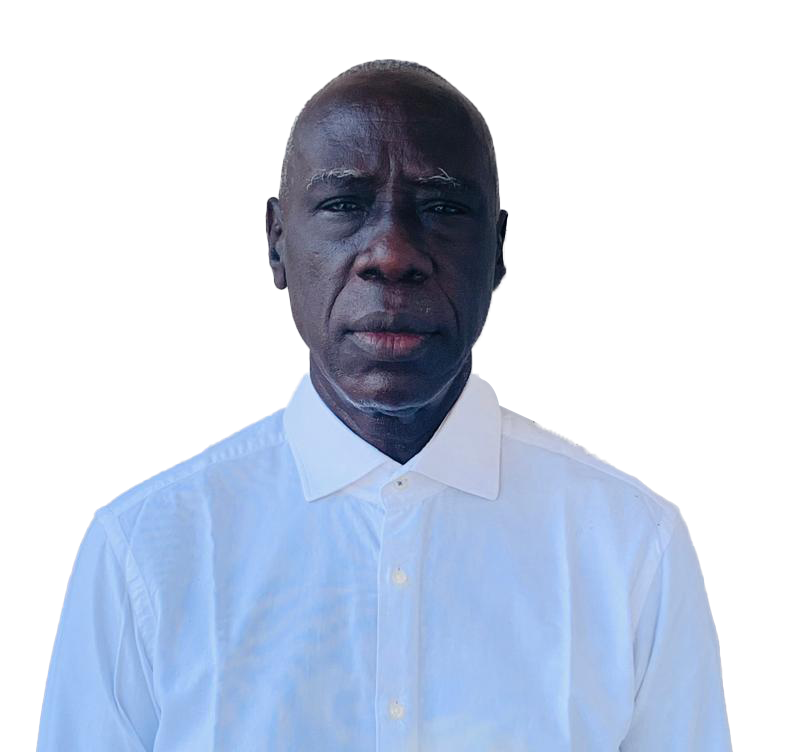
Former police commissioner and analyst at the United Nations, Massamba Ndiaye, looks back on her exceptional career. From Senegal's internal security to international tribunals, the President of the Citizens' Movement Mission for a Popular and Prospere Partnership shares his memories, analyses and political vision for a country he wants to see governed differently.
Diplomatika: Mr. Ndiaye, can you introduce yourself to our readers?
Massamba Ndiaye: I'm a police training commissioner. After the university, where I obtained a master's degree in international law and international relations, I joined the National Police. I headed several regional intelligence services and then the National State Security Brigade in Dakar.
Later, I was appointed Director of the Department of Internal Security in the Prime Minister's Office, where I coordinated the analysis of internal intelligence. Then I pursued a 17-year international career in the United Nations, Bosnia and the International Criminal Tribunal for Rwanda.
Diplomatika: What were Senegal's major security challenges when you led the intelligence?
Massamba Ndiaye: The 1980s and 1990s were marked by major crises. In addition to internal political tensions, serious socio-economic factors caused considerable damage to the image of the socialist regime, which was struggling to provide satisfactory answers.
At the same time, the push of the opposition under the leadership of Master Abdoulaye Wade, surrounded by leaders from other parties, was increasing. On the security front, the emergence of the first fundamentalist organizations was a major concern for the government. We were also facing the conflict in Casamance, marked by heavy suspicions against a neighbouring country accused of supplying arms to the rebellion.
This period also coincided with the emergence of first waves of young people crossing the Malian border and desert to North Africa. If the official pretext was job search, we strongly suspected that some were seeking to join camps training fundamentalist movements.
Finally, socio-political instability in several neighbouring countries and the rise of various cross-border traffic directly threatened the stability of the subregion and Senegal. These global challenges were accompanied by tragic events, such as the very serious electoral violence of 1988, the assassination of Master Babacar Sèye in 1993 and the massacre of 16 February 1994 in which six policemen were killed during a violent march.
The main problem was that the information produced was not always used effectively by the authorities, sometimes leading to preventable tragedies.
Diplomatika: You also witnessed a major episode in Thiès during a PDS meeting...
Massamba Ndiaye: In 1987, the political tension was very strong and the power sought to neutralize Abdoulaye Wade. In this context, I was forced to refuse implicit pressure to write to attribute certain subversive words to Mr. Wade at a monster meeting he had chaired in Thiès. It was a way of preserving civil peace, because such action could have set the situation on fire.
Diplomatika: How did you enter the United Nations?
Massamba Ndiaye: At the United Nations, access to posts is almost systematically through rigorous competitive examinations and recruitment tests. Vacancy announcements are published, and candidates responding to the submitted profiles are tested for playoffs.
It was by this way that I first passed the test to join the office of the United Nations Police Commissioner at the UNMIB mission in Bosnia. It was a temporary position. Subsequently, I passed and passed the Factual Analyst Competition for the Prosecutor's Office of the International Criminal Tribunal for Rwanda (ICTR) in Kigali. I practiced there for ten years.
When the ICTR closed in 2012, it was replaced by the United Nations Residual Mechanism for International Criminal Tribunals. I again passed the recruitment tests to continue my function as a factual analyst in the prosecutor's office. My job was to analyze investigations, assess the robustness of evidence, and provide key reports to build the prosecution.
Diplomatika: What lessons and memories do you keep from your missions in Bosnia and Rwanda?
Massamba Ndiaye: In both Bosnia and Rwanda, these experiences have been deeply marked in human and institutional terms. In Rwanda in particular, I was able to directly measure the devastating ravages of ethnicist propaganda, especially when orchestrated at the highest state summit.
I have seen what happens when a political discourse is based on race, religion or ethnicity: it is a deadly danger to a country, a nation and the cohesion of a state. These abuses show that such discourses and attitudes must be fought tirelessly and never allowed to flourish.
Diplomatika: After 17 years at the United Nations, you returned to Senegal. What prompted you to create a citizen movement?
Massamba Ndiaye: I was shocked to see peasants repressed by grenades thrown at land conflicts. I then decided to launch the People's and Prosperous Partnership Movement. Our goal is simple: to conquer some communes and show that sober, virtuous and non-arrogant management is possible. We uphold fundamental values: democracy, freedom, good governance and respect for human dignity.
Diplomatika: What is your analysis of the current political scene?
Massamba Ndiaye: Senegal lives under a hyper-presidentialism that concentrates too much power in the hands of one man. I advocate a move towards a parliamentary system. I also recall the importance of the silent citizen majority, which makes and defeats the regimes. Leaders often confuse influence and influence, but it is this silent majority who really decides the fate of governments.
Diplomatika: What message do you want to convey to young Senegalese?
Massamba Ndiaye: I tell them to believe in them and aim high. The United Nations offers opportunities, but we must prepare, acquire the foundations and apply. More broadly, I encourage them to commit to their country, to work rigorously and to defend the values of the Republic.
From Senegalese police to the United Nations, then to citizen engagement, Massamba Ndiaye embodies a rare and inspiring trajectory. His journey illustrates the need to link security, international justice and citizen politics to build a resilient and respectful state for its citizens. As he himself recalls, « the silent majority awaits a true politician, not only a public man ».