
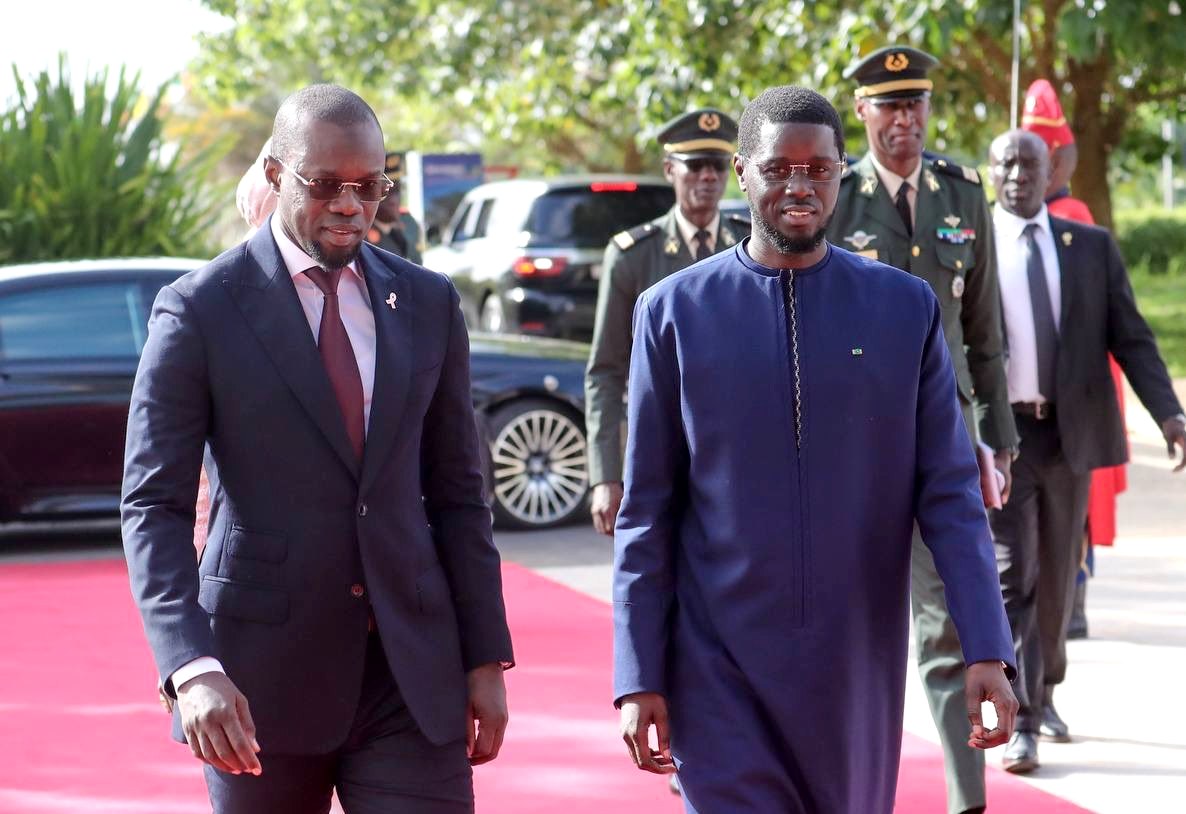
Senegal is entering a new area of political turbulence. President Bassirou Diomaye Faye officially put an end to the functions of Prime Minister Ousmane Sonko and his government, after several months of internal tensions at the state summit.
This break marks a major turning point in the recent history of Senegal, The two men appeared so far as the symbols of the same political project. Arriving in power in 2024 under the banner of Pastef, Diomaye Faye and Soenko had embodied the hope of a break with the old political system. But behind this unit of facade, deep differences seemed to exist for several months, including on state governance, economic orientations and relations with international partners.
Today, this political divorce raises a central question: What will be the consequences of this dismissal on Senegal's relations with its international partners, including the International Monetary Fund (IMF), the European Union, foreign investors and financial markets?
A rupture arising from differences in state administration
According to several media sources, tensions between the two men concerned the method of governance, the management of power and, above all, the economic approach to be adopted in a context of strong fiscal pressure.
Since 2024, Senegal has been going through a delicate economic period:
- suspension of a $1.8 billion programme with the IMF;
- hidden debt cases;
- tensions on public finances;
- investment slowdown;
- very strong social expectations.
In this context, several analysts considered that Ousmane Sonko embodied a more radical and sovereignist economic line, sometimes considered incompatible with certain requirements of international donors.
In particular, the Prime Minister defended:
- renegotiation of mining and energy contracts;
- a challenge to certain international agreements;
- a more nationalistic approach to the economy;
- resistance to austerity policies supported by the IMF.
Conversely, Bassirou Diomaye Faye seemed gradually to adopt a more pragmatic posture to reassure the financial partners and preserve the country's economic stability.
Possible positive consequences
1. A signal of stability sent to financial partners
For some investors and international institutions, the departure of Ousmane Sonko could be interpreted as a calming signal.
For several months, negotiations with the IMF appeared to be slowing down due to internal disagreements within the Senegalese executive. Local media reports, among other things, that Sonko opposed certain debt restructuring measures supported by international partners.
The dismissal could therefore:
- speed up discussions with the IMF;
- reassure financial markets;
- improving the confidence of foreign investors;
- promote the resumption of certain international financing.
Moreover, Finance Minister Sheikh Diba had announced before the dismissal that discussions with the IMF could resume in June 2026.
For some Western partners, this decision could be seen as a desire of President Diomaye Faye to favour a more realistic economic line that is more compatible with international macroeconomic balances.
2. Clarification of the Executive
Dismissal may also lead to institutional clarification.
For several months, many observers have mentioned a difficult coexistence between a president with constitutional power and a prime minister with strong popular legitimacy in the Pastef.
This duality sometimes created a sense of confusion in the conduct of the State. By putting an end to this situation, Diomaye Faye probably tries to reaffirm the presidential authority and avoid a paralysis of power.
3. A potentially more reassuring diplomacy
The departure of Sonko could also help to relax some diplomatic relations with Western partners.
The very sovereignist and sometimes critical positions of Ousmane Sonko vis-à-vis international institutions raised concerns in some diplomatic and economic circles. Its replacement by a more consensual personality could open a new phase of more fluid cooperation with:
- the European Union;
- the World Bank;
- IMF;
- rating agencies;
- Some private investors.
Possible negative consequences
1. The risk of a major political divide
The main danger lies in the risk of division within the Pastef and the presidential majority.
Ousmane Sonko remains today the most popular political figure among a large part of Senegalese youth. His departure could be seen by his supporters as a betrayal of the initial political project carried out since the opposition.
Internal tensions could thus arise:
- fractures within Pastef;
- Parliamentary blockages;
- popular protests;
- frailty of executive power.
2. A period of economic uncertainty
Although some partners might be reassured, markets generally hate political crises.
The Prime Minister's dismissal creates a phase of uncertainty:
- What will be the new government?
- Which economic line will be adopted?
- Will Pastef remain united?
- Will reforms continue?
This instability could temporarily slow down foreign investment and delay important economic decisions.
3. A loss of credibility among some African opinion
In symbolic terms, this rupture could also affect the image of power among African Pan-African movements.
Ousmane Sonko embodied a line of break with old political and economic practices. For some sovereignist militants, his departure could be interpreted as a retreat from international pressure.
This could weaken the image of a Senegal with a new independent and sovereign African path.
The IMF at the heart of the challenges
The International Monetary Fund is now one of the main issues behind this political crisis.
Senegal must restore donor confidence in order to:
- refinance its debt;
- stabilise its public finances;
- support its energy projects;
- preserve its international credibility.
However, several analysts considered that Sonko's very hard positions complicated negotiations with the IMF.
President Diomaye Faye now seems to want to take over in order to avoid a worsening of the economic crisis.
What future for Senegal?
The dismissal of Ousmane Sonko opens a new political sequence whose outcome remains uncertain.
Two scenarios seem possible:
1. A pragmatic refocusing of power
Diomaye Faye could succeed in stabilizing the country, reassure international partners and revive the economy through more moderate governance.
2. A deep political rupture
Conversely, a lasting divide with Sonko could cause a major political crisis, weaken Pastef and revive social tensions.
One thing is certain: this separation between the two most emblematic men of the « Project » deeply changes the Senegalese political landscape. And now, Senegal's international partners will carefully observe the capacity of the President Diomaye Faye maintains both political stability, national sovereignty and international economic confidence.