
Mariarosaria Iorio, Political Analyst
A little bit of history
The Cotonou Agreement (2000-2020) between the European Union (EU) and the African, Caribbean and Pacific (ACP) countries set the framework for the historic partnership between Europe and the ACP countries. The Cotonou Agreement (formerly the Yaoundé and Lomé Conventions) had three main objectives: (i) sustainable development; (ii) regional integration; and (iii) poverty reduction in ACP countries through trade and international cooperation.
The agreement provided for a political dialogue with economic development and preferential access for ACP products to European markets. EU-ACP dialogue and joint programming were at the heart of this partnership, which, while facing its own challenges, was of great importance in the context of international cooperation.
Indeed, the Cotonou Agreement supported the idea that the EU-ACP relationship should place the needs of beneficiary countries at the heart of its programming while knowing that it was a donor-recipient relationship. The aim was to maintain a relationship that should no longer be topdown, as it had been in the past, with a joint identification of projects and programmes.
The dialogue therefore remained donor-recipient, while giving recipient countries the opportunity to voice their priorities and put their concerns on the table. The European Development Fund (EDF) was the financing instrument for the implementation of the Cotonou Agreement..
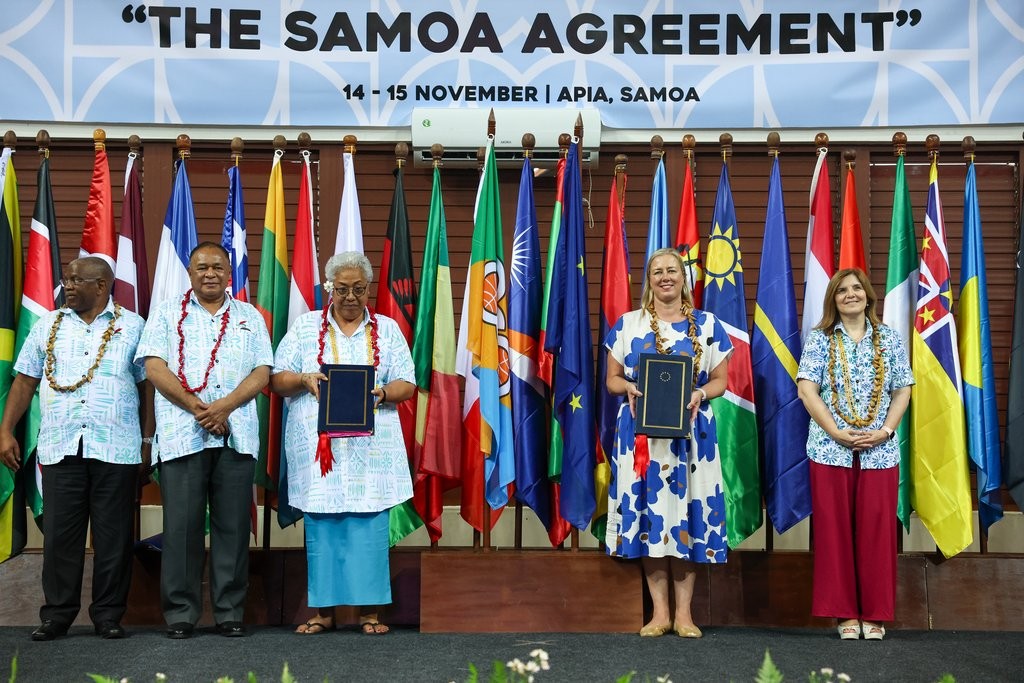
The end of the Cotonou Agreement in 2020 (with extensions until June 2023) marked a paradigm shift leading to the Samoa Agreement (November 2024).
The new paradigm
The discourse on international cooperation and EU-ACP relations has changed in the light of the paradigm shift in global international relations. The expiry of the Cotonou Agreement has in fact coincided with a new global geopolitical context with China that has gained ground in cooperation with Africa. The EU therefore wanted to establish a European strategy for economic diplomacy, including the Global Gateway.
The new European speech now focuses on the economic partnership between equals. The Samoa Accord marks the end of the traditional discourse on public sector-based international cooperation in decentralized management, and places the private sector at the heart of international cooperation.
Indeed, the new paradigm focuses on the common interests of both continents and on the private sector as an engine of economic development in African countries.
The EU's new Global Gateway strategy embodies this change and focuses on promoting European businesses and European interests in third countries. Economic development in African countries would now be driven by the private sector and banking investment.
The EU takes over control of project implementation and programming while re-centralizing project management. Cooperation with Africa is distinct from cooperation with the Caribbean and the Pacific, for which there are two different protocols.
In this context, European and African entrepreneurs must work together to find opportunities and launch joint initiatives. Attention is shifting from public policies to wealth creation by the private sector. The preferred sectors will be infrastructure, transport and digital.
A national framework to support the action of entrepreneurs will also be necessary to ensure a fair redistribution of the wealth created by these actions.
This is the challenge of the future.