

Over the past two decades, Morocco ' s African policy has undergone profound change. For a long time, as South-South cooperation and the strengthening of diplomatic relations, Morocco ' s African policy now relies on an increasingly strong economic and infrastructure presence, in an environment marked by increasing competition between regional and international powers.
This dynamic, however, invites us to go beyond a strictly economic reading. More than just instruments of cooperation, investment and infrastructure are part of a geo-economic projection strategy aimed at strengthening Morocco's presence and positioning on the continent. It is through this reading grid that this article examines the growing role of economic diplomacy in the African policy of the Kingdom.
Africa, a strategic space at the heart of economic restructuring
Few today are the powers that do not seek to strengthen their presence in Africa. From Beijing to Brussels, from Ankara to Abu Dhabi, initiatives are increasing on a continent that has become one of the main areas of economic and strategic competition. Investments in infrastructure, critical minerals, energy, telecommunications and logistics now reflect an interest that goes beyond commercial opportunities.
This dynamic shows a shift: Africa is no longer just a space for development, but a space where power relations are redesigned..
This attraction is based on several factors. With a population expected to reach nearly 2.5 billion by 2050, Africa is both an expanding market and one of the world's largest labour pools. The continent also concentrates significant strategic resources, including cobalt and lithium, which have become essential for the energy transition and the development of digital technologies. In addition to these advantages, the gradual implementation of the African Continental Free Trade Area (AFTAAf), which promotes market integration and strengthens the attractiveness of the continent for investors.
In this context, China is continuing the development of the New Silk Roads, the European Union is accelerating the deployment of its Global Gateway programme, while the Gulf countries, Turkey, India and the United States are increasing their investment in infrastructure, logistics chains, energy and technology.
The challenge is no longer just to access new markets, but also to secure strategic supplies, organize trade flows and strengthen its influence in a region that is expected to play an increasing role in global economic balances.
In this new environment, influence no longer depends solely on diplomatic or military capabilities, but also on the ability of States to structure trade, investment and infrastructure. It is precisely in this recomposition that Morocco's African strategy is now in place.
Economy as a new lever of Moroccan African policy
The affirmation of Moroccan economic diplomacy in Africa is neither the result of an ad hoc initiative nor a sudden reorientation of the Kingdom's foreign policy. Since the early 2000s, Morocco has gradually made the economy a central lever of its African policy, without breaking the principles of solidarity and cooperation that have long characterized its relations with the States of the continent..
This is reflected in an increasing emphasis on economic partnerships, long-term investment and value-creating projects, which are seen as the foundations of a sustainable presence. The intensification of royal visits, the proliferation of cooperation agreements and the establishment of Moroccan companies illustrate this dynamic. Long before its return to the African Union in 2017, the Kingdom had already strengthened its presence in several African economies through the banking, agricultural, energy and training sectors. Its reintegration has thus consolidated a strategy already under way by providing a more favourable political and institutional framework.
It is in this evolution that the geo-economic projection of Morocco takes place. Investment, infrastructure, financial services, telecommunications and major connectivity projects no longer meet economic objectives only but become instruments of external action to structure economic spaces, organise flows and create sustainable interdependencies. The challenge is no longer simply to develop trade, but to anchor Morocco in Africa's economic dynamics in a sustainable way, with effects that now go beyond the economic sphere.
National enterprises at the heart of geo-economic projection
Morocco's economic presence in Africa is largely based on its national enterprises, which have become the main vectors of its anchoring on the continent.
More than a strategy of commercial expansion, their establishment allows the Kingdom to gradually integrate into partner economies and build sustainable relationships.
The banking sector offers the most significant illustration. Through Attijariwafa Bank, Bank of Africa and the Central People's Bank, Morocco has gradually been integrated into African financial systems. In Congo, for example, Bank of Africa holds 38.2% of BOA-Congo's capital. This presence goes beyond bank financing by accompanying investments, promoting integration into local financial networks and strengthening the Kingdom's economic presence on a sustainable basis.
The same logic is observed in the agricultural sector. Through OCP Africa, Morocco is not limited to exporting fertilizers, but develops training programmes, agronomic research and local production of fertilizers, particularly in Nigeria and Ethiopia. By contributing to the modernization of agricultural sectors, OCP is making a lasting contribution to Morocco's presence in a strategic sector for many African States.
This strategy is also found in other sectors. Present in eleven African countries and with more than 81 million customers, Maroc Telecom is involved in the development of digital ecosystems. Addoha supports several real estate projects in Ivory Coast, Senegal, Guinea and Ghana, while ONEE mobilizes Moroccan expertise in water, electricity and sanitation.
Taken as a whole, these actors perform a function that goes beyond their only economic activity. By integrating into key sectors of African economies, they create interdependencies that permanently consolidate Morocco's presence on the continent. For an intermediate power, this ability to anchor in financial, agricultural and digital structures is a major geo-economic lever, reinforcing its position by a structured economic presence rather than by confrontation.
Organize flows, strengthen influence
Beyond its national enterprises, Morocco relies on infrastructure to strengthen its geo-economic projection. More than just equipment, ports, logistics corridors and energy projects become instruments for organising the continent's main trade flows.
The port complex of Tangier Med and the future Port Dakhla Atlantic illustrate this strategy. While the former has established itself as a hub linking Africa to European and international markets, the latter aims to strengthen the Atlantic opening of the Kingdom while providing new opportunities for access to Sahelian states.
Designed to process up to 35 million tons of goods per year, Port Dakhla Atlantic is one of the structuring projects of the Atlantic Initiative. It is thus contributing to the emergence of new trade corridors oriented towards the Atlantic façade and to the strengthening of Morocco's role as an interface between the Sahel, Atlantic Africa and international markets, in a context of increasing competition around the main logistics axes.
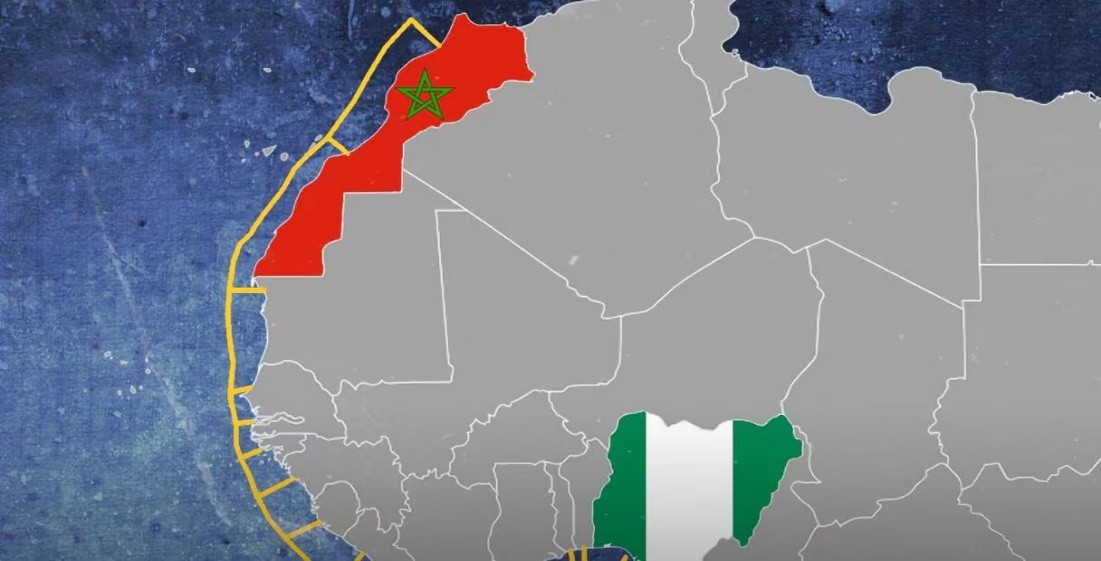
The African-Atlantic pipeline responds to a similar logic. Connecting Nigeria to Morocco through several West African countriesIt goes beyond energy issues by creating a corridor capable of repositioning the Kingdom at the heart of future African gas flows. It is also part of a competition between connectivity projects, notably with the Trans-Saharan Gas Pipeline led by Nigeria, Niger and Algeria. More than just transport infrastructure, these projects become geo-economic instruments to organize flows, create interdependences and strengthen the strategic positioning of the states that carry them.
This logic extends that observed through national enterprises. Banking groups favour Morocco's anchoring in African financial systems, OCP helps to structure agricultural value chains, while logistics and energy infrastructure organize regional flows. Together, these levers reflect the same strategy as for an intermediate power like Morocco, the influence rests less on coercion than on the ability to structure areas of cooperation and gradually strengthen its position in the main economic dynamics of Africa.
Upstream, this economic anchor also produces political effects. Without reducing African partnerships to transactional logic, the densification of financial, industrial and infrastructural ties contributes to strengthening the diplomatic credibility of the Kingdom, broadening its partnerships and consolidating its positions on issues of strategic interest, including those related to its territorial integrity. The economy thus appears less as an end in itself than as a foreign policy instrument, transforming a sustainable economic presence into diplomatic capital in an African environment marked by increasing competition between powers.
Thus, the macroeconomic projection of Morocco recalls that in Africa, influence is no longer measured solely by the scale of investment, but by the capacity to structure spaces, organize flows and create lasting interdependences. For an intermediate power, these mechanisms offer the possibility of consolidating a regional presence and gradually increasing its influence without resorting to the traditional instruments of power.
As African balances recompose, this capacity could become one of the main markers of power in the 21st century. It also calls for a rethinking of contemporary forms of influence, where the control of economic networks gradually complements, or even redefines, the traditional sources of international action.
Doctor in International Relations
Mohammed V University of Rabat