
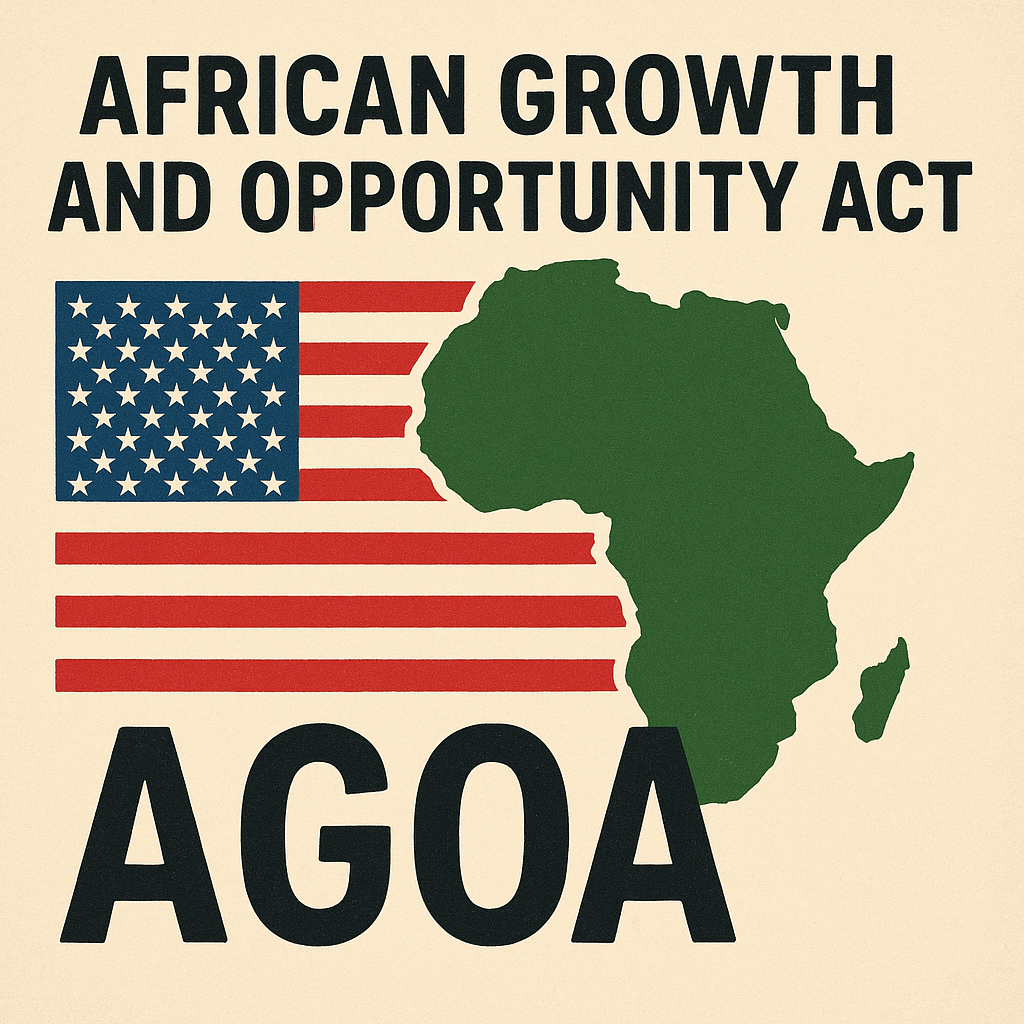
For more than two decades, trade relations between the United States and sub-Saharan Africa have been structured by the African Growth and Opportunity Act (AGOA), a unilateral preference scheme covering nearly 1,800 tariff lines. In 2024, African exports to the United States reached USD 30.1 billion (USTR, 2025), confirming the still central role of AGOA in the trade architecture between the two regions.
ABOE Franck, graduate of the Institute of International Relations of Cameroon.
However, between 2025 and 2026, this system went through the most uncertain period in its history: on 30 September 2025, provisional reactivation until 31 December 2026 in February 2026, and then, adoption by the US Senate on 7-8 August 2026, an extension until 31 December 2028 (HR 6500, 90 votes to 6).
The text is still to be reconciled with the House of Representatives, which had voted in January 2026 a close version before promulgation expected in September. This embellishment, however welcome, does not dispel the now explicit requirement of reciprocity formulated by Washington, nor the persistence of the International Emergency Economic Powers Act (IEEPA), section 232, which continues to neutralize part of the AGOA preferences for several countries.
This challenge comes as other powers intensify their offers to the continent: China extended the zero customs tariff from 1 May 2026 to 53 African countries, bringing China-Africa trade to USD 348 billion in 2025 (+17.7 per cent); The European Union is pursuing its Global Gateway strategy, with an Africa package of around EUR 150 billion by 2027.
This article argues that none of these external offers is a substitute for a continental strategy based on four levers: regional integration via the FTACAFA, local resource transformation, pragmatic diversification of partnerships and building productive capacity. The analysis mobilizes the trade data of the World Bank, UNCTAD, USITC and ECA, as well as the latest specialized press, to update a debate that saw several major inflections between January and August 2026.
AGOA: a contrasting balance in the face of apparently more generous competing offers
Adopted in May 2000 under the Clinton administration on a principled basis « Trade, not aid »AGOA is based on non-reciprocal preferential access, subject to criteria of governance, workers' rights and the fight against corruption reviewed annually by presidential proclamation.
Of 49 potentially eligible countries, only 30 (32 today) actually benefit from the scheme at a given time ; Cameroon, which has been excluded since 2020 on human rights grounds, is still excluded from this game.r.
US imports under the AGOA regime amounted to USD 10.3 billion in 2022 far from the peak of 2008 (USD 104.7 billion in total trade) with a high concentration of oil and geographical concentration (South Africa, Nigeria, Angola). Beyond hydrocarbons, two sectors stand out: South African automobiles and textiles and clothing in East and Southern Africa, which employs several hundred thousand workers. These successes remain the exception: the majority of eligible countries have never developed a competitive export chain to the US market.
A textile specific provision, the « third country fabric provision », allows the least developed countries to use fabrics imported from third countries while retaining the eligibility of their finished clothing a decisive relaxation for Lesotho, Madagascar or Kenya, each of which employs tens to hundreds of thousands of workers directly related to exports to the United States.
The retention of this derogation in the text voted in August 2026 directly conditions the survival of these sectors, as the Malagasy and Mauritian industrialists point out, for which the issue now exceeds the only tariff rate to deal with predictability and cost competitiveness vis-à-vis Asian producers.
A comparison that relates to competing offers
Chinese zero tariff does not impose any political conditionality, but also no local transformation requirement It mainly benefits the diversification of manufacturing exports to China, with a marginal effect on African agricultural and mining exports (The Conversation, 2026), and benefits structurally the already most industrialized economies. The European Global Gateway stands out for its focus on social and environmental standards, but remains criticized for its slow implementation and the large share of loans rather than donations (FNTP, 2026). Neither is a substitute for an autonomous African industrial policy.
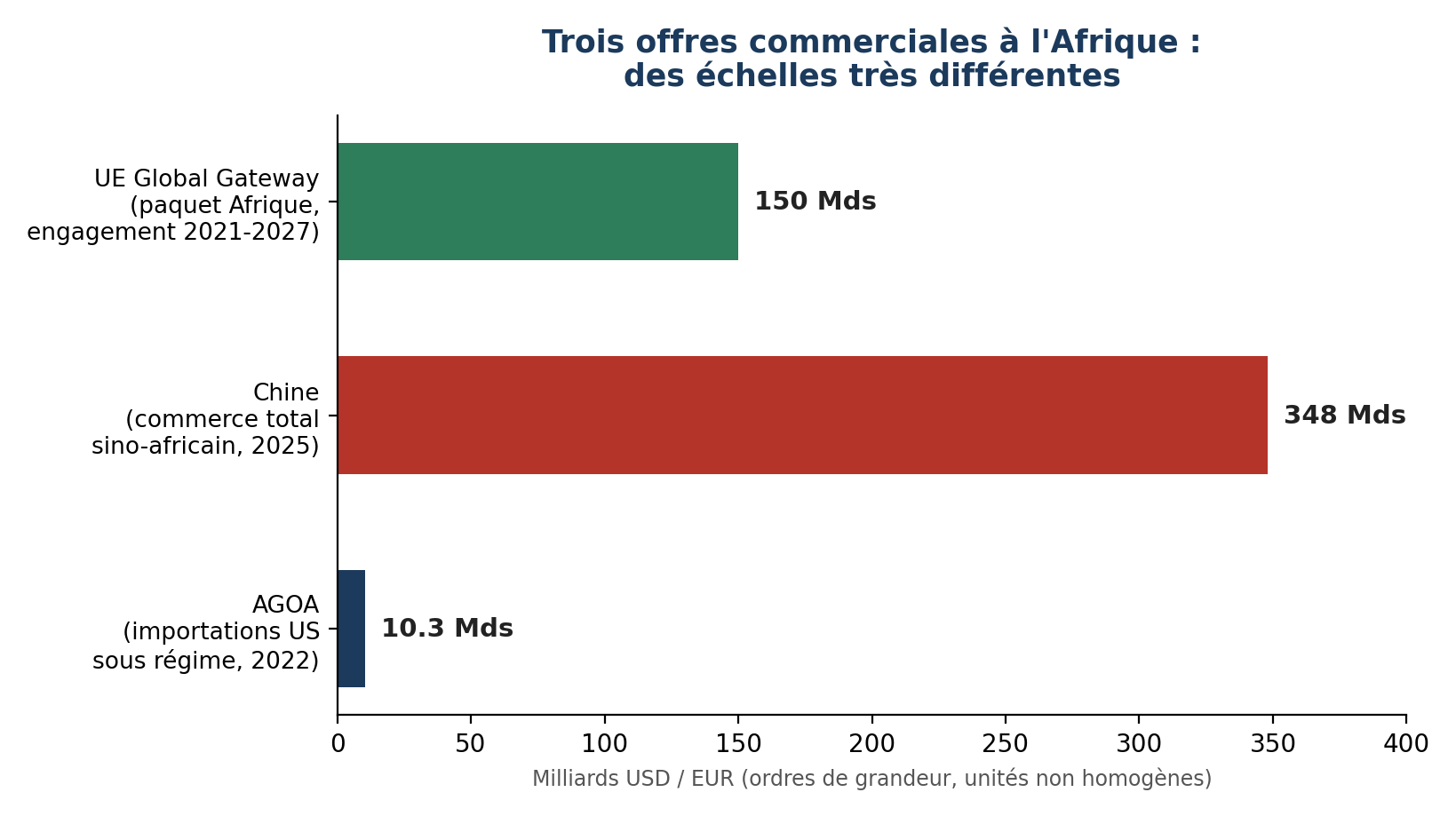
Figure 1: Three regimes, three logics: conditional market access (AGOA), unconditional access without value added requirement (China), financing of partial and slow infrastructure (EU). Sources: USITC (2023), Africanews/Xinhua (2026), European Commission (2026).
The American Mercantist Reorientation and the Legislative Break of 2026
Since the mid-2010s, the United States has been implementing a mercantilist shift in favour of reciprocal pricing and securing strategic supply chains (critical minerals, agreements with the DRC).
Rates « reciprocal » in April 2025 superimposed on AGOA preferences, creating legal insecurity denounced by South African and Kenyan employers' federations. The South African case with a 30% tariff and threatened exclusion from the Miami G20 summit illustrates the geopolitical instrumentalisation of the system.
The legislative series of the AGOA Extension Act (H.R. 6500) summarizes these tensions: adopted by the House in January 2026 for an extension of three years, reduced to one year by the Senate in February (re-activation retroactive until December 31, 2026), and then, a notable turnaround, adopted by the Senate on August 7-8, 2026, with a large bipartisan majority (90 votes to 6) for an extension until December 31, 2028, signifies that the coalition favouring African trade has, for the time being, taken over the strictly transactional wing of the administration.
The amended text has yet to be re-elected to the House in September before President Trump's promulgation, which should be accompanied by an implementing decree. The ITC (2025) estimated that a definitive expiry would have cost USD 189 million in exports to beneficiary countries by 2029, including USD 138 million for textiles alone, a scenario that the extension voted in August 2026 would allow to be excluded, subject to its final conclusion.
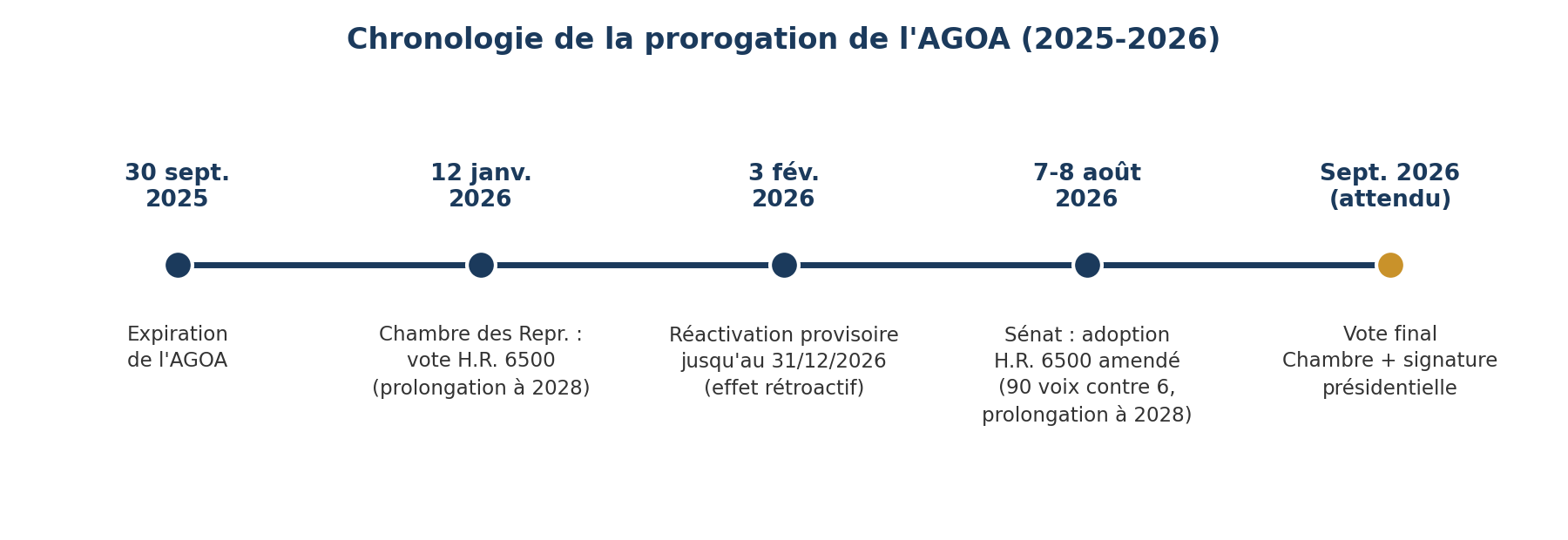
Figure 2: The AGOA's path struck between 2025 and 2026, between expiration, temporary reactivations and extension in the process of being activated until 2028.
Addressing post-AGOA uncertainty: an African empowerment strategy
The FTACAF remains the most structuring lever: intra-African trade reached USD 220.3 billion in 2024 (+12.4 per cent), with an expected share of around 16 per cent of total African trade in 2026 far from the 54.5 per cent of Asia and 68.4 per cent of Europe.
The World Bank (April 2026) even notes an increase in non-tariff barriers and logistics costs since the entry into force of the agreement, which remained 50 per cent above the world average. Thirty years after the creation of the WTO, Africa's share of world trade in goods increased from 5 per cent (1994) to 2.8 per cent (2025), indicating that successive US, Chinese or European unilateral preferences alone do not reverse the trend.
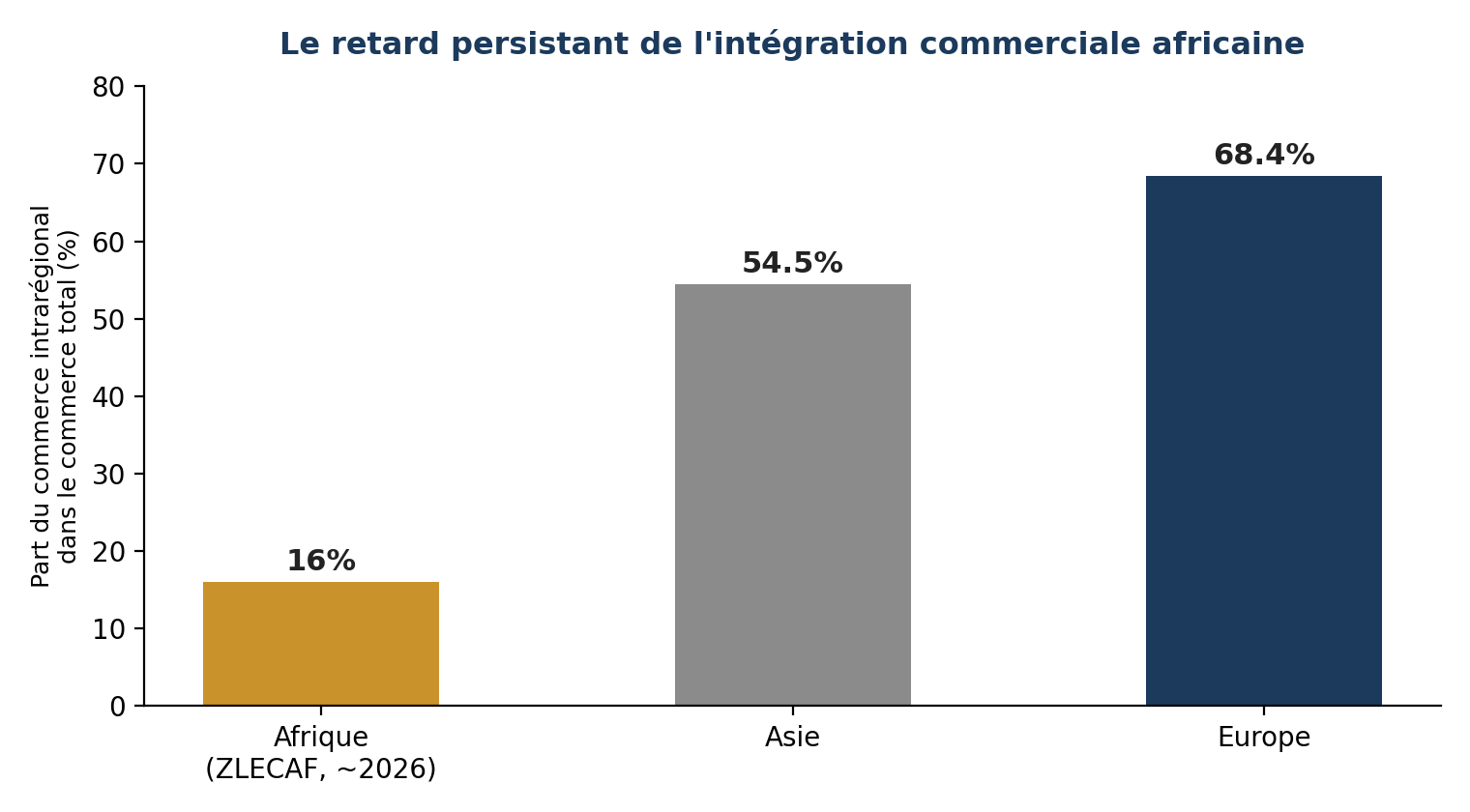
Figure 3: Intra-African trade integration remains well below other major regional groupings. Sources: Afreximbank (2025-2026), UNCTAD, ECA (2026).
Local resource transformation conditions the value of preferential access: the manufacturing share of Africa's GDP has stagnated below 13% since 2020, while the DRC has almost tripled the value of its cobalt exports by transforming it locally (US$ 6 billion in 2022, compared to US$ 167 million for crude ore).
Finally, a pragmatic diversification of critical green energy and minerals partnerships with the US, deepening EPAs with the EU, enhancing China's status as China's first trading partner must be accompanied by sustained investment in infrastructure (estimated energy deficit of USD 190 billion per year) and human capital, failing which trade preferences, whatever their origin, will remain mere short-term economic effects.
Digital economy over 500 million mobile broadband subscriptions and an estimated US$5.76 billion e-commerce market by 2033 In this respect offers a complementary route to partially bypass the physical infrastructure deficit, provided that technical training and support for small and medium-sized exporting enterprises follow.
The extension of the AGOA until 2028, in the process of being acted upon after the Senate vote of 7-8 August 2026, offers Africa unprecedented visibility since the expiration of September 2025. But neither this American respite, nor the Chinese zero tariff, nor the European Global Gateway exempt the continent from building its own tools of empowerment.
The decline in Africa's share of world trade (5 to 2.8 per cent between 1994 and 2025) and the widening of intra-African trade barriers despite the FTACAF remind us that trade openness, unilateral or negotiated, only produces development if it is linked to a proactive industrial policy. Regional integration, local resource transformation, multi-partner economic diplomacy and investment in infrastructure and human capital remain the most secure levers for Africa to cease to be a competitive field between external powers.